SAT and ACT prep

Practice tests that coach the test.

Sit a full, timed practice test built the way each test is built. Then see where the points went and where your clock went. Every miss says why your pick was wrong, and comes back in review. Cora can go over the whole test with you.

For students sitting the digital SAT or the ACT.

  • Over 1,100 original questions
  • Adaptive digital SAT
  • ACT with Science on its own
  • An estimate, never a predicted score
A full SAT practice test in the web app. Math, module 2, question 4 of 22, with 33:28 on the clock. The question asks which equation shifts the graph of y equals f of x 3 units to the right and 2 units up; the answer chosen is A, y equals f of x minus 3, plus 2.
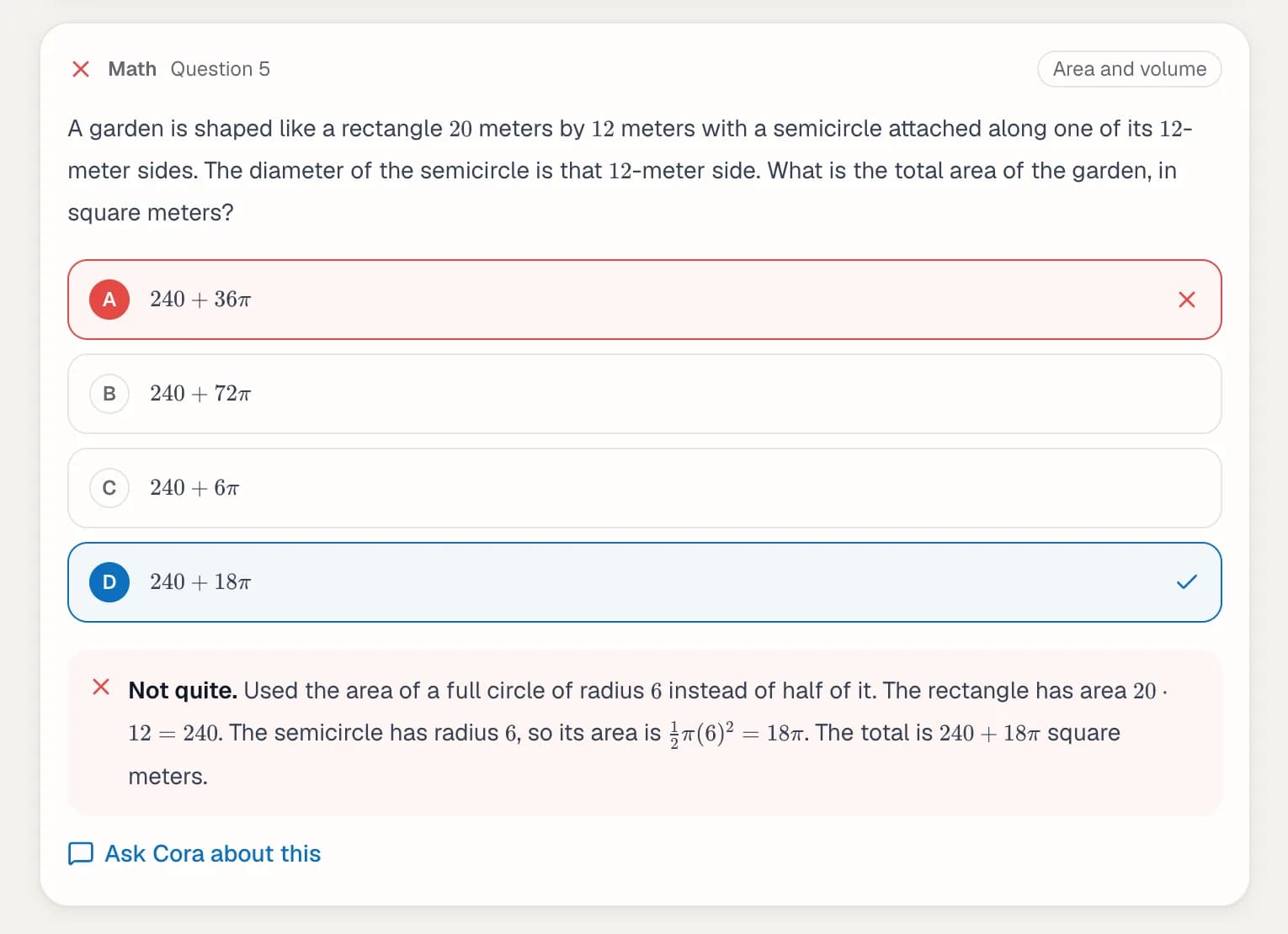
A missed SAT Math question in the results. A garden is a 20 by 12 meter rectangle with a semicircle on a 12-meter side. The pick, 240 plus 36 pi, is crossed out and 240 plus 18 pi is ticked. The note says: Not quite. Used the area of a full circle of radius 6 instead of half of it. Then the working, and an Ask Cora about this link.

Real screenshots: a full SAT in progress, and a missed question in the report after a diagnostic.

The tests

Built the way each test is built.

The same sections, question counts and clocks as each real test. The shapes below are read straight from the blueprint the app builds every sitting from.

Digital SAT

134 min of testing · 10-min break

  1. Reading and Writing · module 127 questions · 32 min
  2. Reading and Writing · module 227 questions · 32 minEasier or harder, from module 1
  3. Break10 min
  4. Math · module 122 questions · 35 min
  5. Math · module 222 questions · 35 minEasier or harder, from module 1

Module 2 of each section depends on how module 1 went, as on the real test.

ACT

165 min of testing · 10-min break

  1. English50 questions · 35 min
  2. Math45 questions · 50 min
  3. Break10 min
  4. Reading36 questions · 40 min
  5. Science40 questions · 40 minOptional · own score

Science is optional. It is reported on its own, outside the composite.

What it does

From the first question to the last miss, on screen.

Six parts, each shown as it looks in the web app today. The answers in these screenshots were worked for real.

01Practice tests

Full-length and timed, like the real thing.

A full practice test runs every section on the real clocks. You can also start with a short diagnostic.

A module's clock does not stop. It keeps running if you close the tab, as on test day. You can stop between modules: the next one starts when you press Start.

  • On the ACT, each passage sits beside its questions.
  • Flag a question, and check your work before you hand a module in.
  • The break falls where each real test has one.
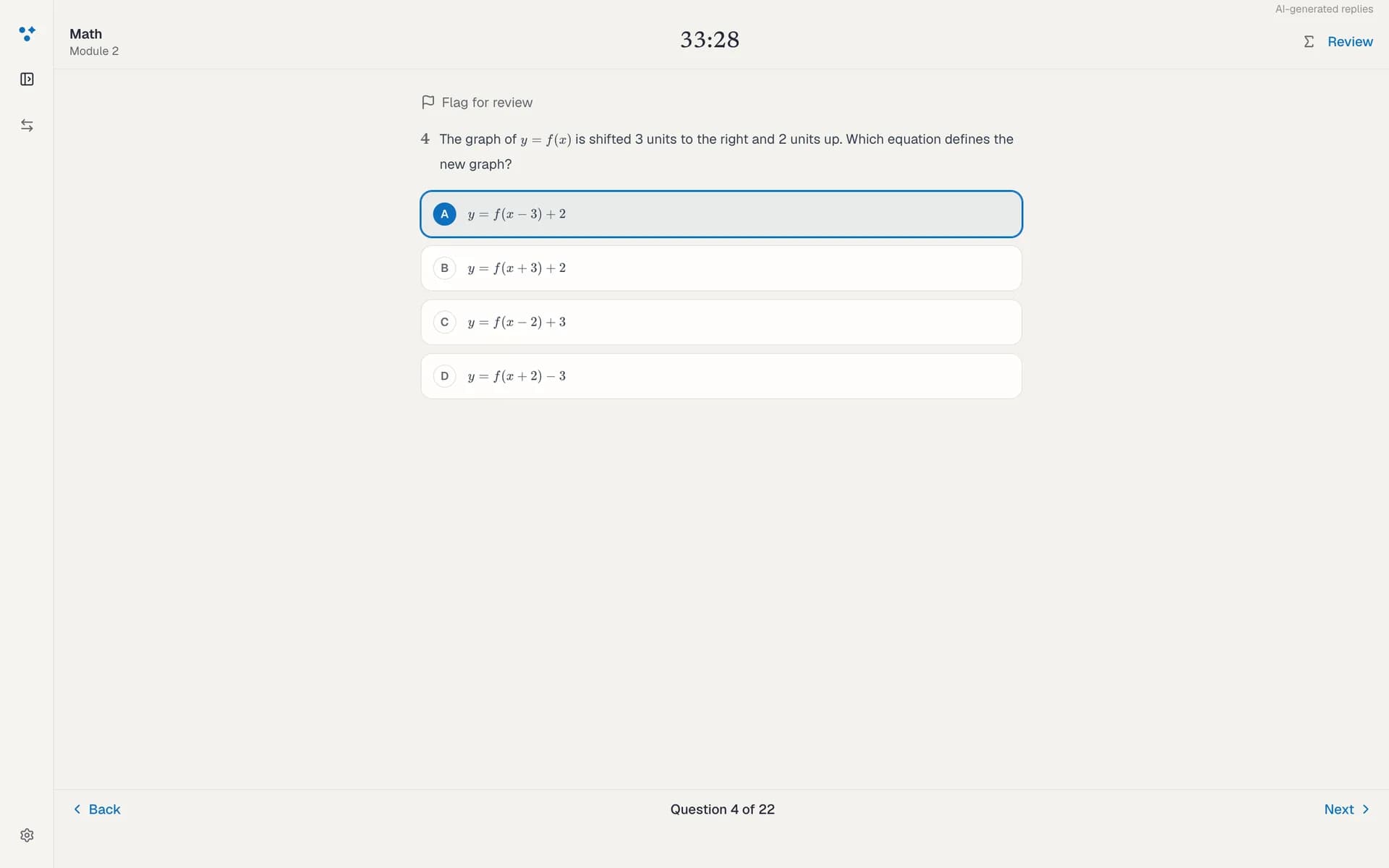
A full SAT practice test in the web app. Math, module 2, question 4 of 22, with 33:28 on the clock. The question asks which equation shifts the graph of y equals f of x 3 units to the right and 2 units up; the answer chosen is A, y equals f of x minus 3, plus 2.
Real screenshot. A full SAT in progress: Math, module 2, 22 questions on a 35-minute clock.
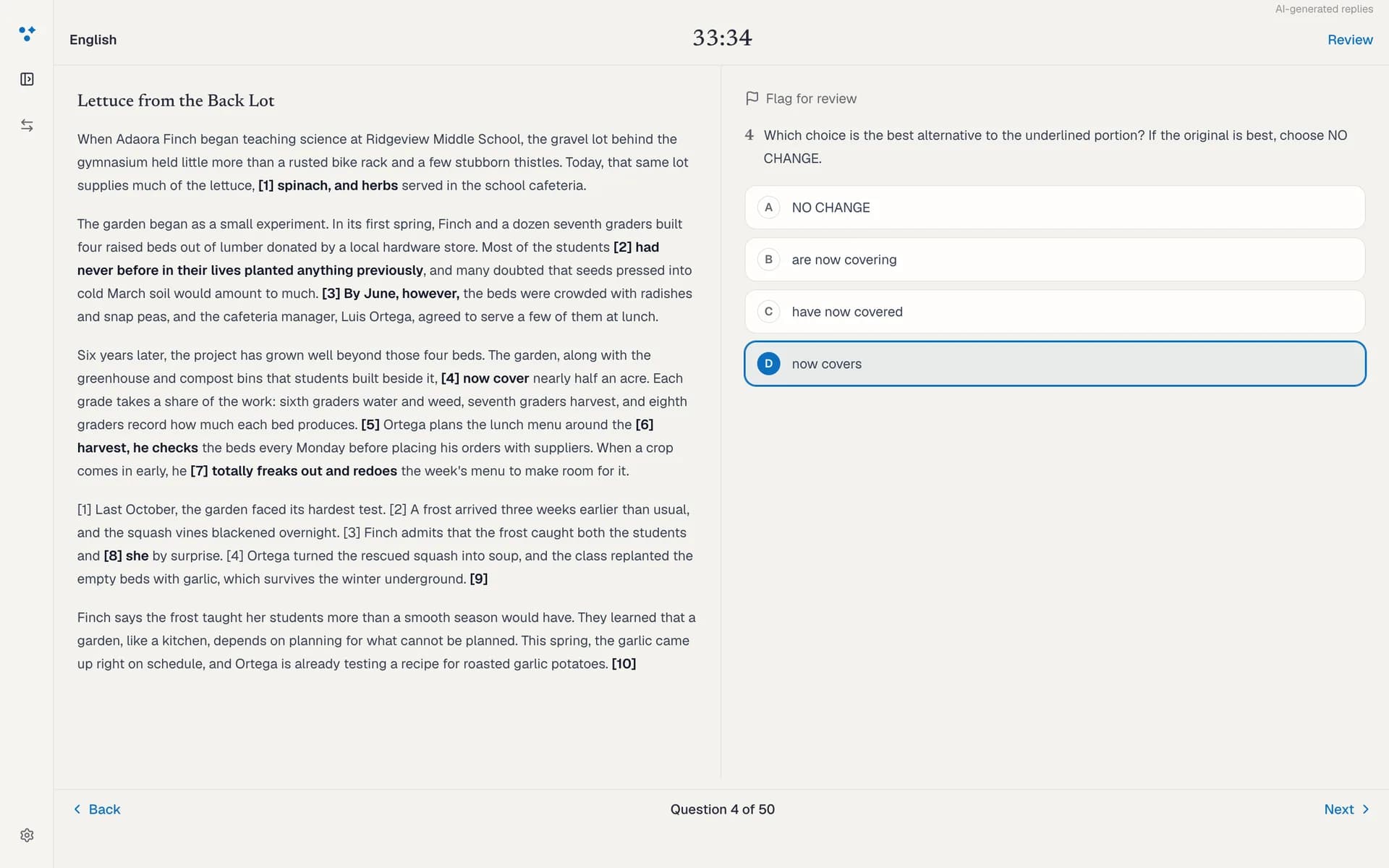
A full ACT practice test in the web app. English, question 4 of 50, with 33:34 on the clock. The passage, Lettuce from the Back Lot, is on the left with numbered underlined portions. The question is on the right, answered D, now covers.
Real screenshot. A full ACT in progress: English, 50 questions, the passage beside the question.

02The digital SAT

An SAT that adapts, the way the real one does.

How you do on module 1 decides whether module 2 is the easier or the harder one. The practice test works the same way.

Some math questions take a typed-in answer. They are marked by the test's own entry rules.

  • The report says which second module you got, and what that means for how high the score can go.
  • Marking is exact. No model decides whether you were right.
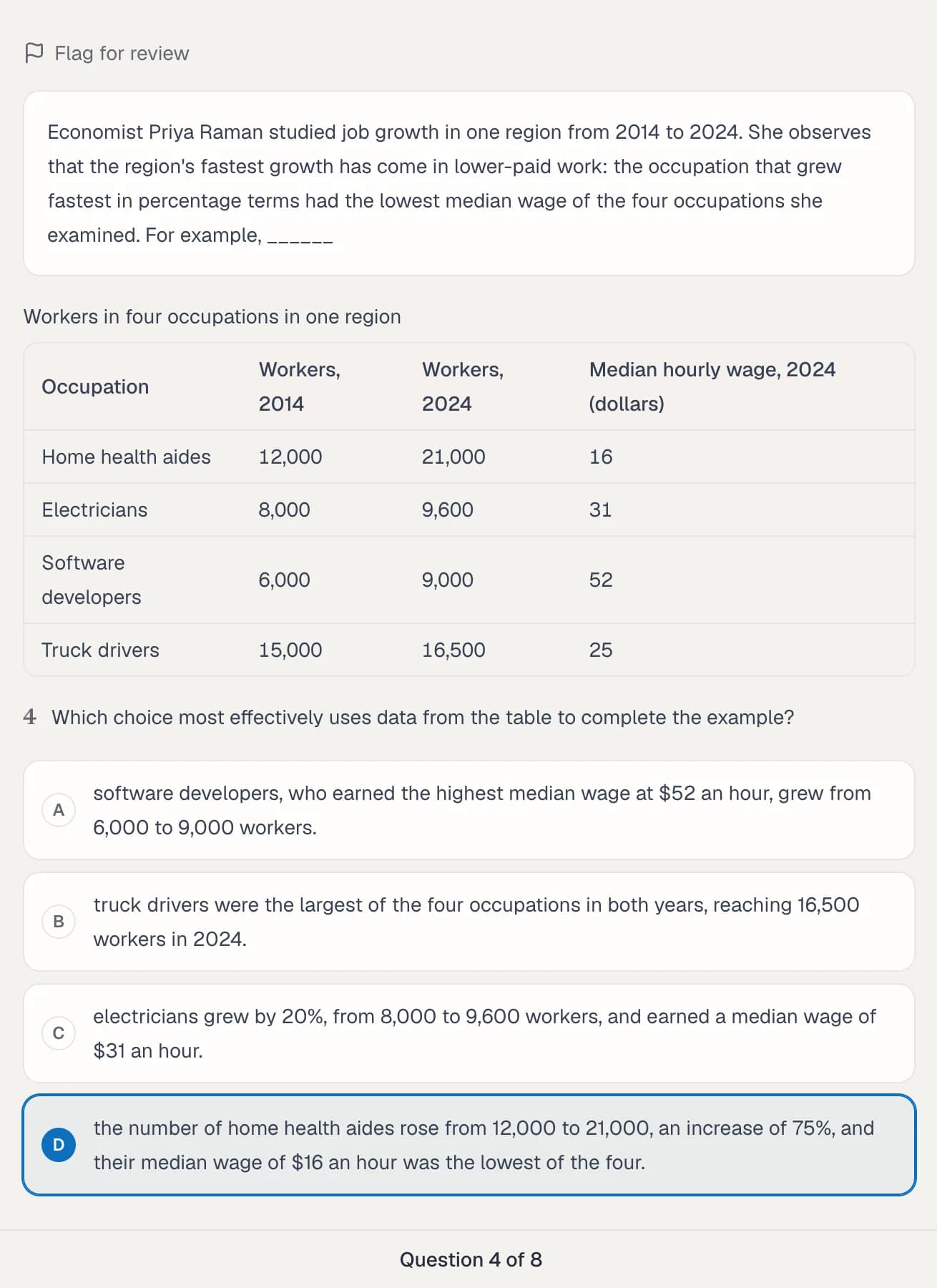
An SAT Reading and Writing question, 4 of 8: a short text about job growth, a table of workers in four occupations in 2014 and 2024 with their median wages, and four choices. The last choice is selected.
Real screenshot. Reading and Writing: a question that asks you to read a table.
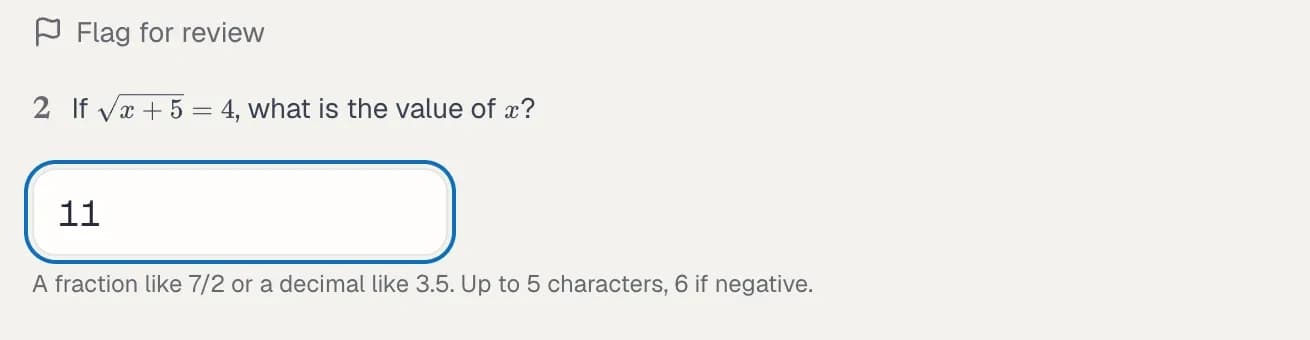
An SAT Math question with a typed-in answer: if the square root of x plus 5 equals 4, what is the value of x? The answer field holds 11, with the entry rules below it: a fraction like 7/2 or a decimal like 3.5, up to 5 characters, 6 if negative.
Real screenshot. A typed-in math answer, with the test's own entry rules under the field.

03The report

See where the points went, and where the minutes went.

After every test you get a report. It breaks your result down by domain, weakest first.

It lists what to practise first, each with a link to the method. It shows how long each module took.

Your result is shown as a band from our own scoring model, labelled an estimate. It is never a predicted score.

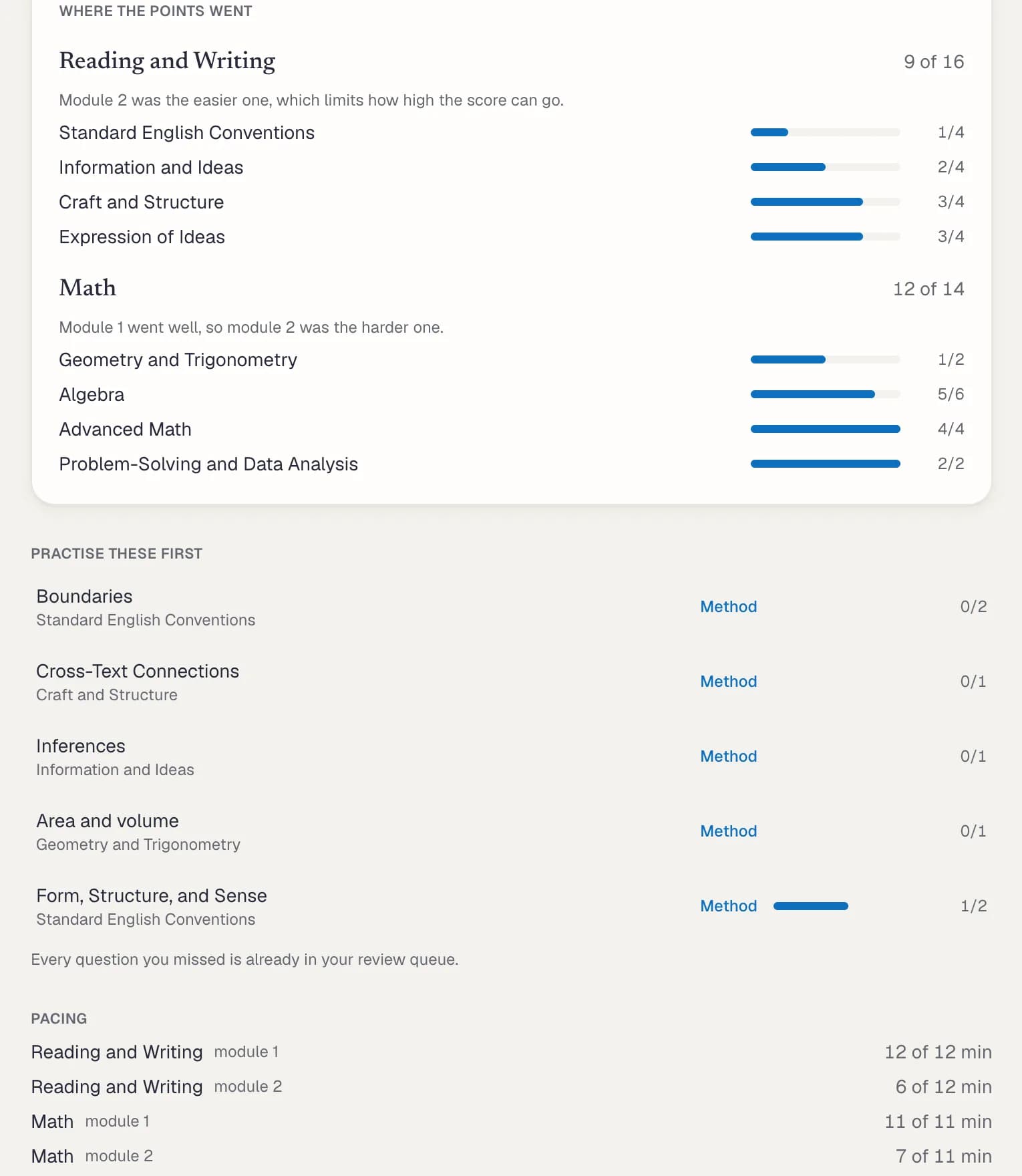
An SAT results page, below the estimated bands. Where the points went: Reading and Writing, 9 of 16, and module 2 was the easier one, which limits how high the score can go. Math, 12 of 14, and module 1 went well, so module 2 was the harder one. Bars for each domain. Practise these first: Boundaries, Cross-Text Connections, Inferences, Area and volume, and Form, Structure and Sense, each with a Method link. Every question you missed is already in your review queue. Pacing: minutes used in each module.
Real screenshot. After the test: where the points went, what to practise first, and the clock.

04Every question

Every miss says what went wrong with your pick.

Every question is in the report, with its explanation.

When you miss, it says what went wrong with the answer you chose. Not only why the right one is right.

Every miss is already in your review queue. "Ask Cora about this" opens a chat about that one question.

A missed SAT Math question in the results. A garden is a 20 by 12 meter rectangle with a semicircle on a 12-meter side. The pick, 240 plus 36 pi, is crossed out and 240 plus 18 pi is ticked. The note says: Not quite. Used the area of a full circle of radius 6 instead of half of it. Then the working, and an Ask Cora about this link.
Real screenshot. Every miss says what went wrong with your pick, not only what was right.

05Your patterns

The traps that keep catching you, counted.

Every wrong option in the question bank is tagged with the trap it sets. There are 37 of them, from sign slips to choices that claim too much.

Across your tests, the page counts which traps keep catching you. Each one comes with a drill to practise spotting it, and a lesson on how to avoid it.

It also flags misses that came too fast, well under the pace.

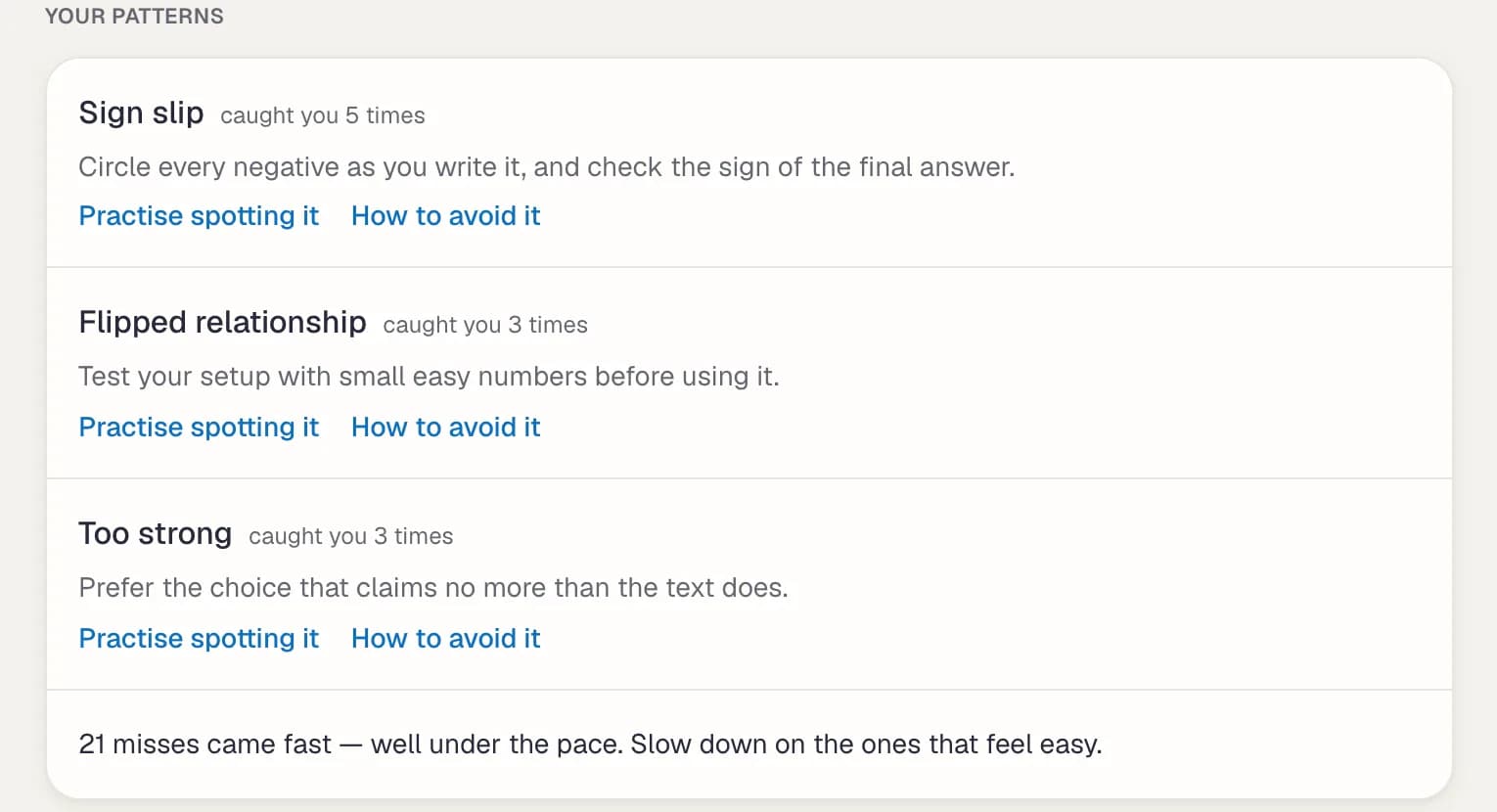
Your patterns, on the SAT page. Sign slip, caught you 5 times: circle every negative as you write it. Flipped relationship, caught you 3 times: test your setup with small easy numbers. Too strong, caught you 3 times: prefer the choice that claims no more than the text does. Each has Practise spotting it and How to avoid it. Below: 21 misses came fast, well under the pace; slow down on the ones that feel easy.
Real screenshot. Your patterns: the traps that keep catching you, counted across your tests.

06Strategy

Lessons on how each test asks.

49 strategy lessons across both tests. Each one says how to spot the question type, gives a method, and has a question to try.

Practise by skill, weakest first, across every skill the test covers. Pacing drills run a set at the section's own pace.

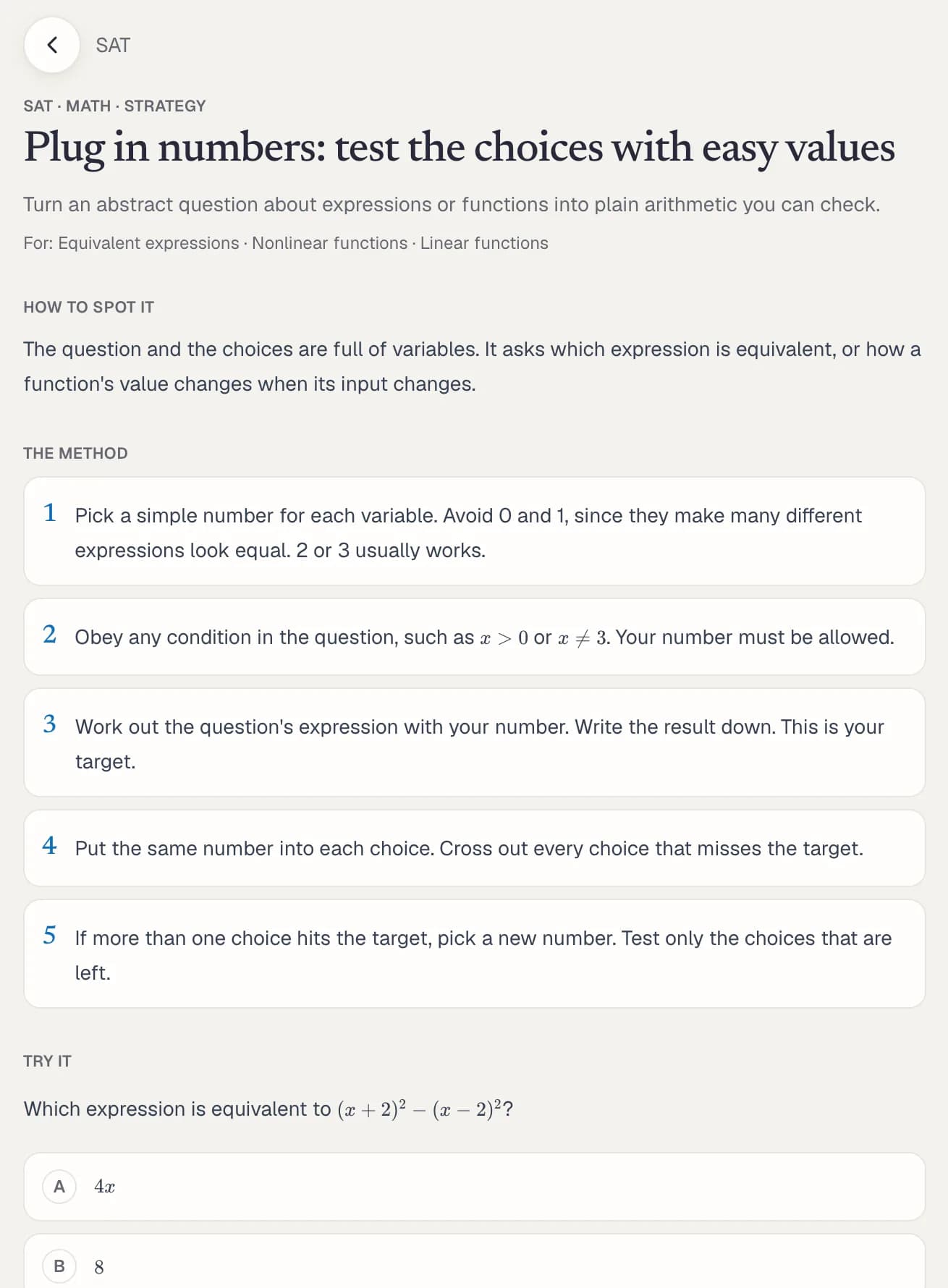
An SAT strategy lesson: Plug in numbers, test the choices with easy values. How to spot it, a five-step method, and a Try it question.
Real screenshot. A method lesson, linked from the skills and traps it fixes.

Then Cora coaches the test itself.

A score tells you how it went. Coaching tells you what to do next: the questions that ate your clock, the trap you keep falling for, and the faster way through.

Go over the test with Cora

From the report, one tap opens a chat. Cora already has every answer, your pacing, and why each miss happened. She starts with the big picture, then goes over misses one at a time. She asks what you were thinking before she explains.

A plan paced to test day

Tell it your test date. The plan starts with a diagnostic, then works section by section, weakest skills first, with full practice tests along the way. After each test, it adds practice for what went wrong, including pacing.

One plan covers the SAT, the ACT and 13 AP courses.

Pricing

Pay once for the test.

SAT/ACT prep is an add-on to Base. You never need it to use the tutor. Pay for it once, and it is yours to keep.

Compare every plan

SAT/ACT prep

Launch pricing

Full-length SAT and ACT practice, and the report after each.

$15onceor $35 for AP prep and SAT/ACT prep together
  • Needs Base ($20 / month): every subject, the canvas, plans and review
  • Full-length timed SAT and ACT practice tests, and the report after each
  • One payment, and it is yours to keep
  • 14 days free to start, with no card

FAQ

Questions, answered.

Something not here? Write to us and a person answers: support@getcorollary.app.

SAT and ACT

Are these real SAT or ACT questions?

No. Every question is original, written in the style of each test, and never a real test item. Each answer key was checked by a second, independent solve that never saw the key: a separate AI model, with code checking the math.

Will it predict my score?

No. After practice you see a band for each section, labelled an estimate. It is never a predicted score, and it moves as your practice does.

Is the digital SAT adaptive here?

Yes. How you do on the first module decides which second module you get, as on the real test. Typed-in math answers are graded by the test's own rules.

Can I pause a practice test?

Not inside a module. Its clock keeps running, even if you close the tab, as on test day. You can stop between modules: the next one starts when you press Start. The break falls where the real test has one.

What do I get after a practice test?

A report. It shows where the points went, domain by domain, and which second module you got on the SAT. It lists what to practise first and how long each module took. Every question has its explanation, including why your pick was wrong, and every miss is already in your review queue. Cora can go over the whole test with you.

What does it cost?

SAT and ACT prep is a one-time add-on to Base: $15, paid once and yours to keep. AP prep is $20, and both together are $35. Base is $20 a month. Every plan starts with the same 14-day trial and no card.

Pick your test date. The plan starts from there.

Free for 14 days. No card.

SAT is a registered trademark of the College Board, and ACT is a registered trademark of ACT, Inc. Neither was involved in or endorses this product. Practice questions are original, written in the style of each test, never real test items.