AP prep · 13 courses

AP practice exams, marked point by point.

Sit a full practice exam on the clock. Cora marks each free response against its rubric, point by point. Every lost point says why, and comes back in review. Your plan follows the course outline and is paced to exam day.

For students sitting an AP exam, in any of 13 courses from Precalculus to Microeconomics.

  • 13 AP courses
  • Over 2,000 practice questions
  • Full practice exams
  • Never a predicted score
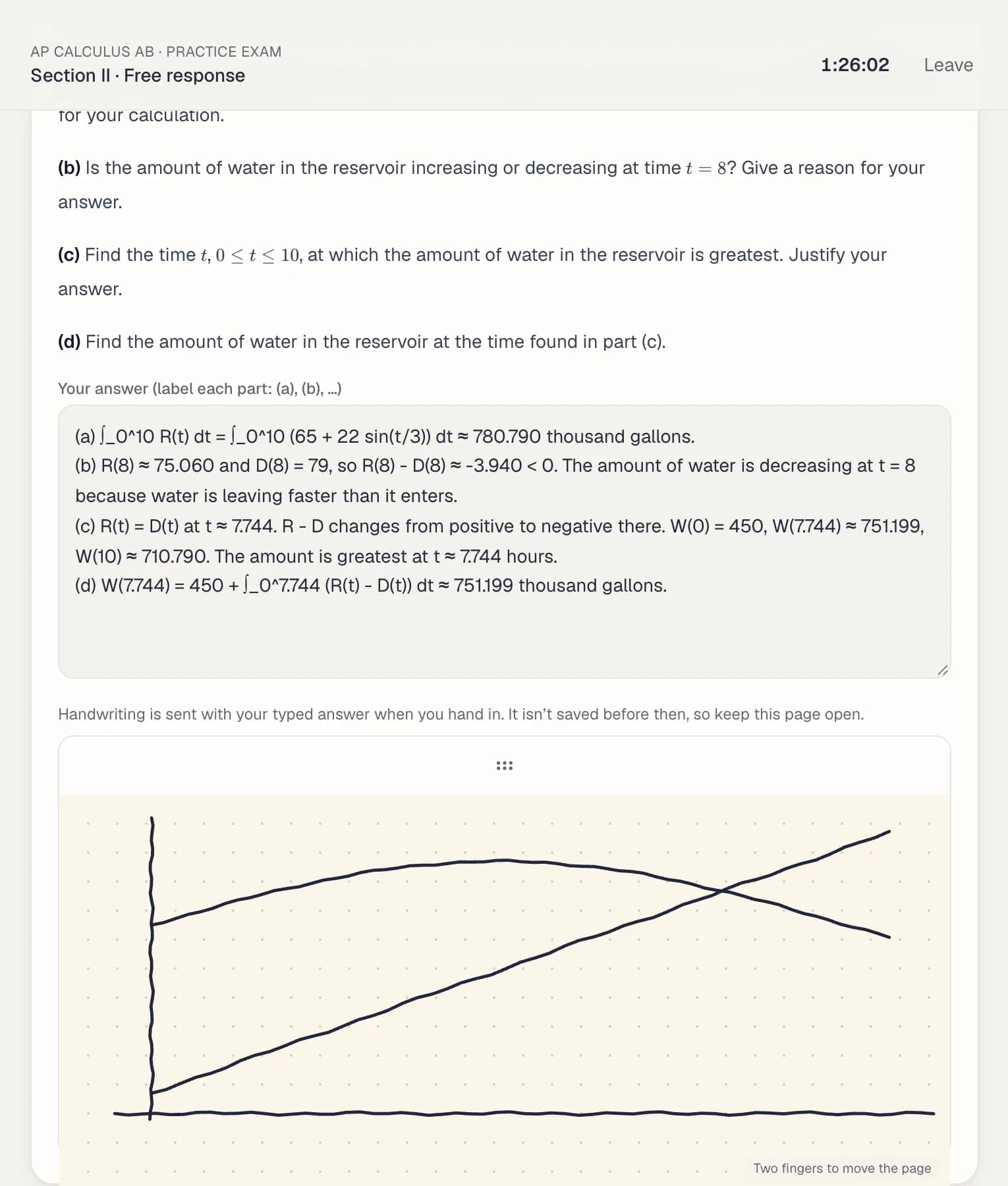
Section II of the same practice exam, with 1:26:02 left. A question about the water in a reservoir, parts (b) to (d) in view, with a typed answer to all four parts under it, and below that a handwriting pad with a rough sketch of the two rates.
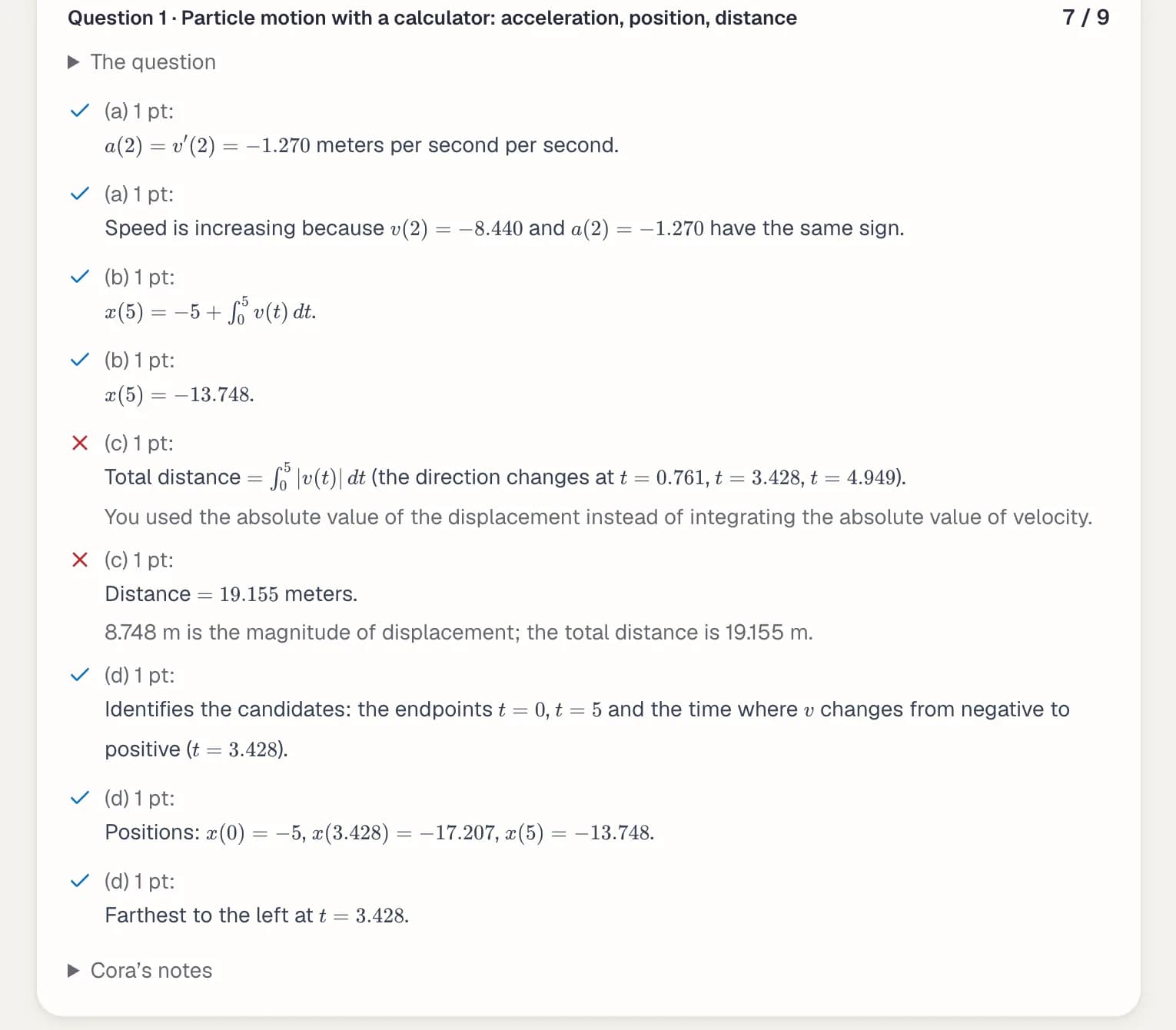
The marked free response, 7 out of 9. Nine rubric points, each with a tick or a cross. Both points in part (c) are crossed, with the reasons: you used the absolute value of the displacement instead of integrating the absolute value of velocity, and 8.748 meters is the magnitude of displacement while the total distance is 19.155 meters.

Real screenshots: Section II of an AP Calculus AB practice exam, and one answer marked point by point.

What it does

Everything the AP layer does, on screen.

Six parts, each shown as it looks in the web app today. The answers in these screenshots were worked for real, and the marking is the grader's own.

01The plan

A plan built from the course outline, paced to your exam.

Pick a course and Cora lays out the whole outline as a study plan. Every unit and every topic, in order.

It comes from the public course outline. It is not made up by a model. Each unit ends in practice, and checkpoints mix units the way the exam does.

The plan counts back from exam day and tells you the pace, in steps a week.

  • Fall behind, and it offers to reshape the plan with you.
  • After a practice exam, rework for your two weakest units goes in ahead of the rest.
  • A step can end in a short exit ticket you do without help.
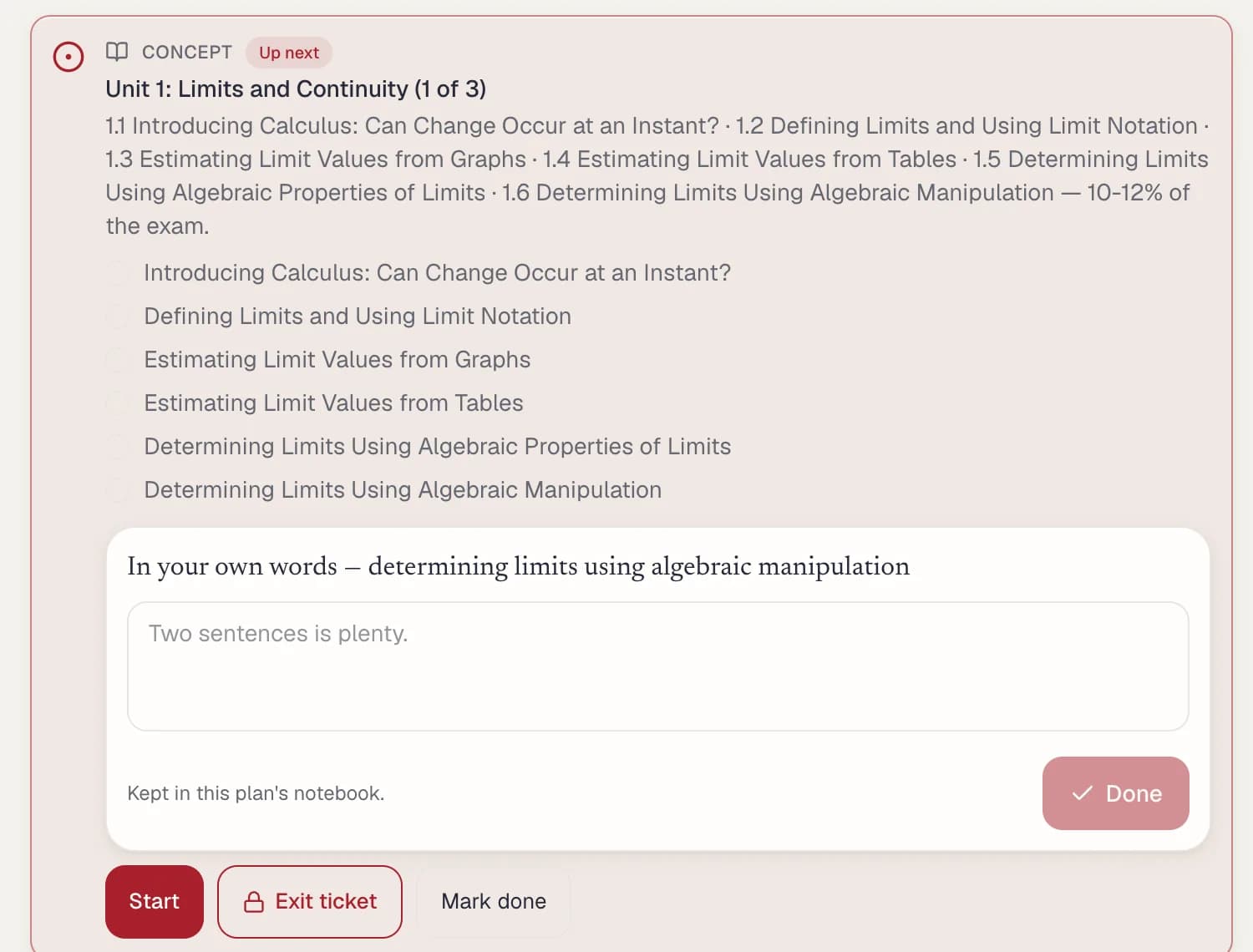
The first step of an AP Calculus AB plan: Unit 1, Limits and Continuity, 1 of 3, listing course topics 1.1 to 1.6 and 10 to 12 percent of the exam, with an In your own words box and Start, Exit ticket and Mark done buttons.
Real screenshot. A plan step, taken from the course outline, down to the topic numbers.

02Practice exams

Full practice exams, on the clock.

A practice exam has both sections. Multiple choice comes first, then free response. Each section has its own clock, as on exam day.

The clock does not pause. When time runs out you move on, and at the end the paper is handed in.

Every paper is new. It draws on questions you have not met yet.

  • Section I is marked exactly, unit by unit.
  • Section II answers can be typed, written by hand, or both.
  • You see what you scored on that paper. Never a guess at your AP score.
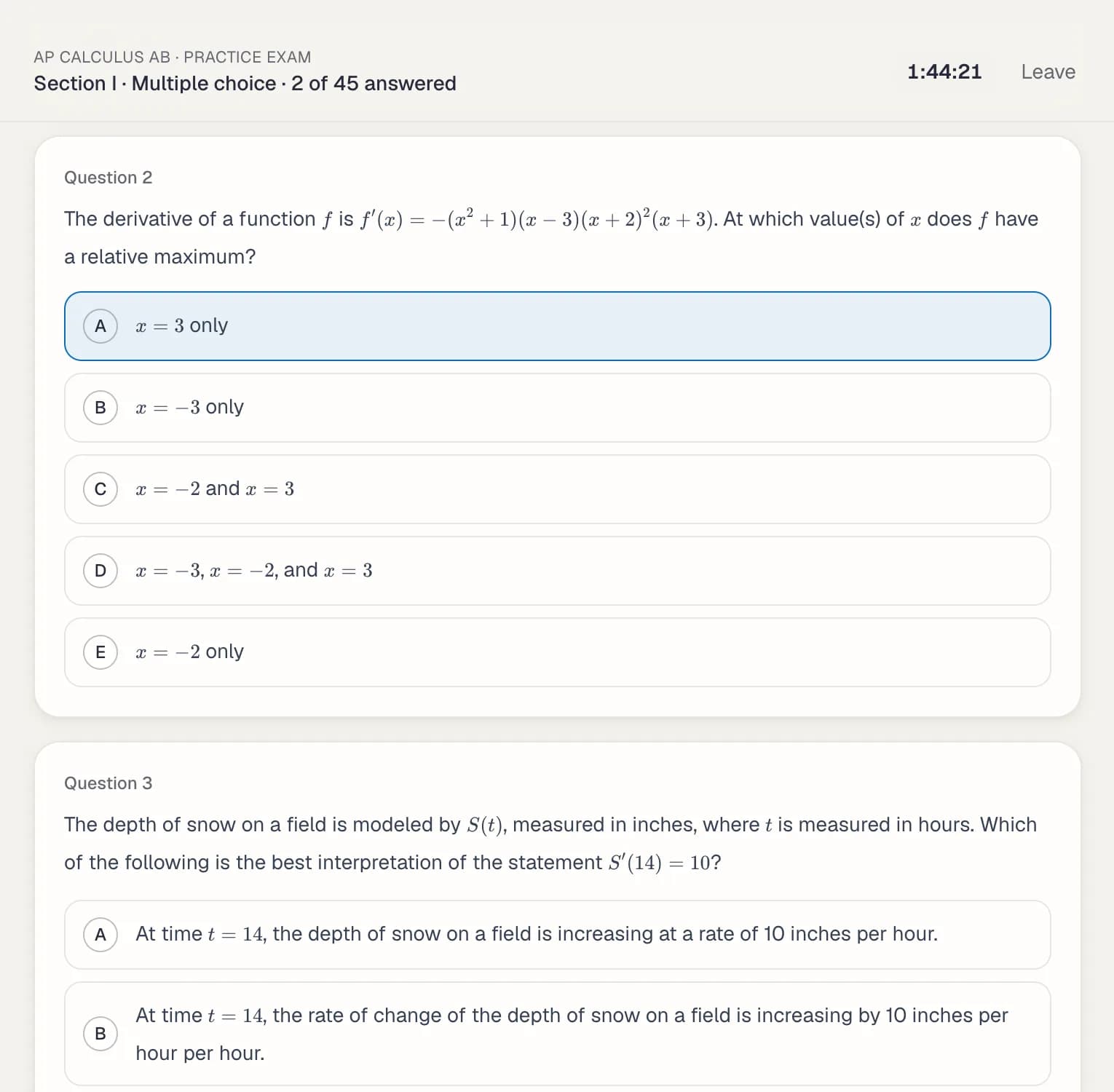
An AP Calculus AB practice exam in the web app. Section I, multiple choice, 2 of 45 answered, with the section clock at 1:44:21. Question 2 gives a derivative in factored form and asks where f has a relative maximum; x equals 3 only is selected. Question 3, on what S prime of 14 equals 10 says about the depth of snow on a field, is below.
Real screenshot. Section I of an AP Calculus AB practice exam: 45 questions, one clock.

03Free response

Every point marked, with the reason it was lost.

Cora reads your answer against the question's rubric. Each point is marked earned or not.

A lost point always says why. It names what went wrong in your answer, not just what the right one was.

If the grader cannot be reached, the answer shows as not marked. It is never scored as zero.

“You used the absolute value of the displacement instead of integrating the absolute value of velocity.”

The grader, on part (c) of the answer shown
The marked free response, 7 out of 9. Nine rubric points, each with a tick or a cross. Both points in part (c) are crossed, with the reasons: you used the absolute value of the displacement instead of integrating the absolute value of velocity, and 8.748 meters is the magnitude of displacement while the total distance is 19.155 meters.
Real screenshot. A typed answer, marked by the grader. Every point says earned or not, and why.

04Where you stand

Where you stand, unit by unit.

Each unit fills in as it gets marked work. One plain phrase says how that work went.

It names the units that are still thin, so you know where to go next.

Marked handwritten work counts for more than what you say about yourself. It is never a prediction of your score.

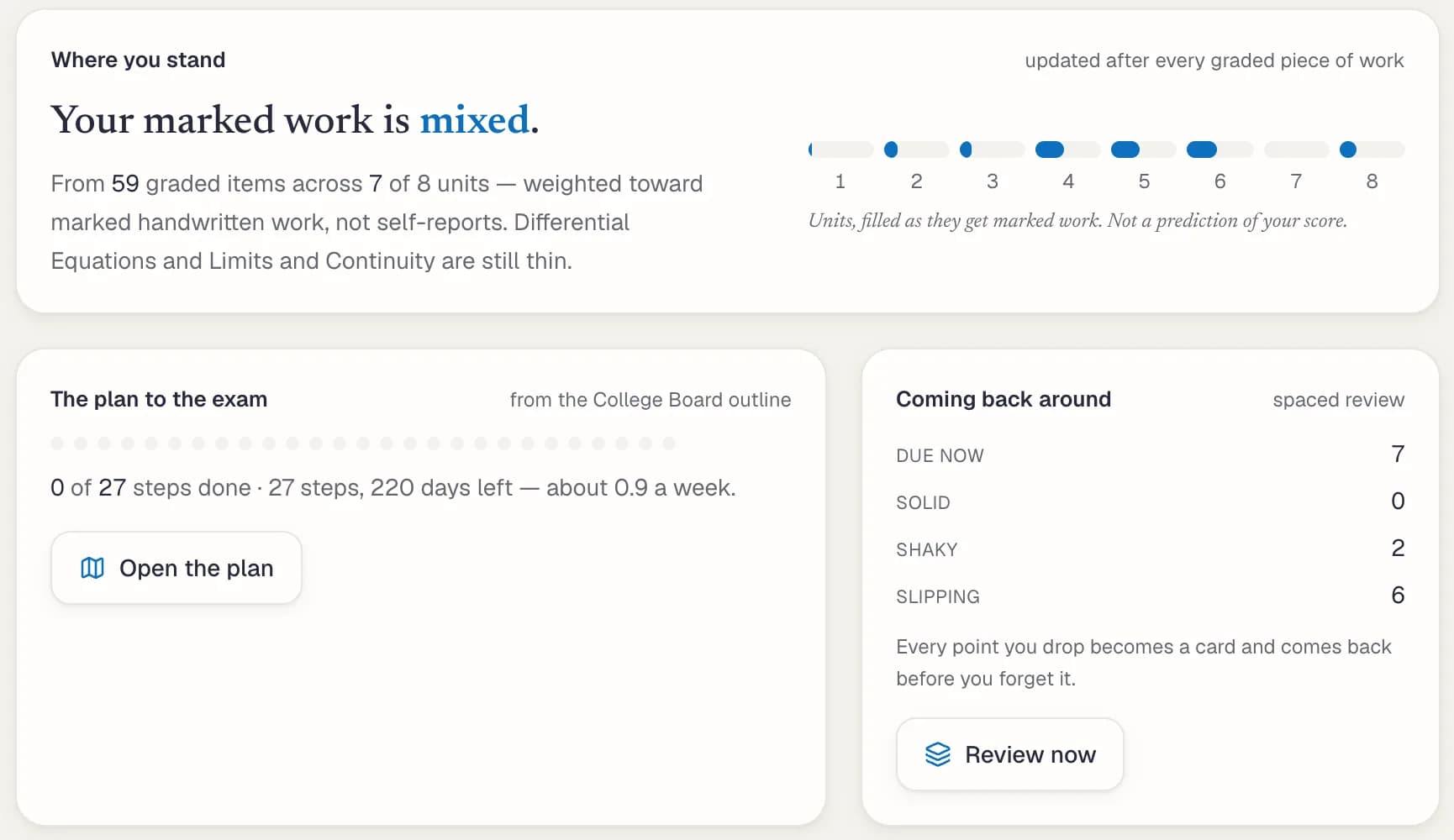
The AP Calculus AB course page. Where you stand: your marked work is mixed, from 59 graded items across 7 of 8 units; Differential Equations and Limits and Continuity are still thin. Eight unit bars, labelled not a prediction of your score. The plan to the exam, from the College Board outline: 0 of 27 steps done, about 0.9 a week. Coming back around: 7 cards due, 2 shaky, 6 slipping.
Real screenshot. The course page: where you stand, the plan, and what comes back for review.

05Practice and review

Misses come back until they stick.

Multiple-choice practice checks itself the moment you answer. A wrong pick names the mistake behind it.

Every point you drop becomes a review card, on a practice exam or in practice. Cards come back on a spaced schedule, before you forget.

  • Over 2,000 multiple-choice questions across the courses.
  • Each one explains every wrong option, not just the right one.
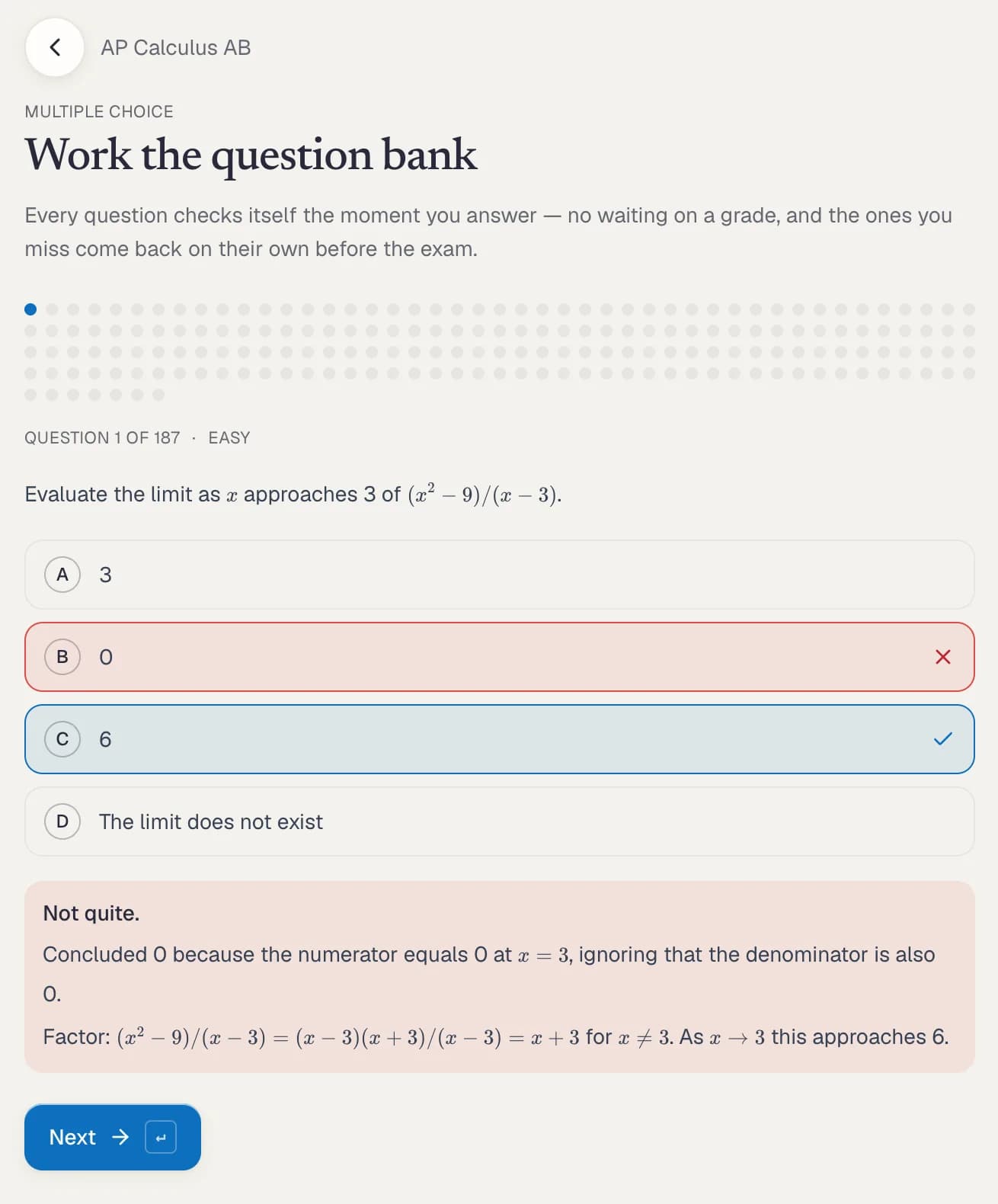
AP Calculus AB multiple-choice practice, question 1 of 187: the limit of x squared minus 9 over x minus 3 as x approaches 3. The pick, 0, is marked wrong and 6 is marked right. The note says: Concluded 0 because the numerator equals 0 at x equals 3, ignoring that the denominator is also 0. Then it factors the expression.
Real screenshot. Multiple choice checks itself, and names the mistake behind the wrong pick.

06How to earn the points

Learn how the points are handed out.

Strategy lessons show what readers look for in each kind of course. Each one has a method and a worked example, marked point by point.

There are lessons on pacing Section I and on exam day itself.

After a practice exam, Cora can go over it with you. She already has every point you earned or missed, and why.

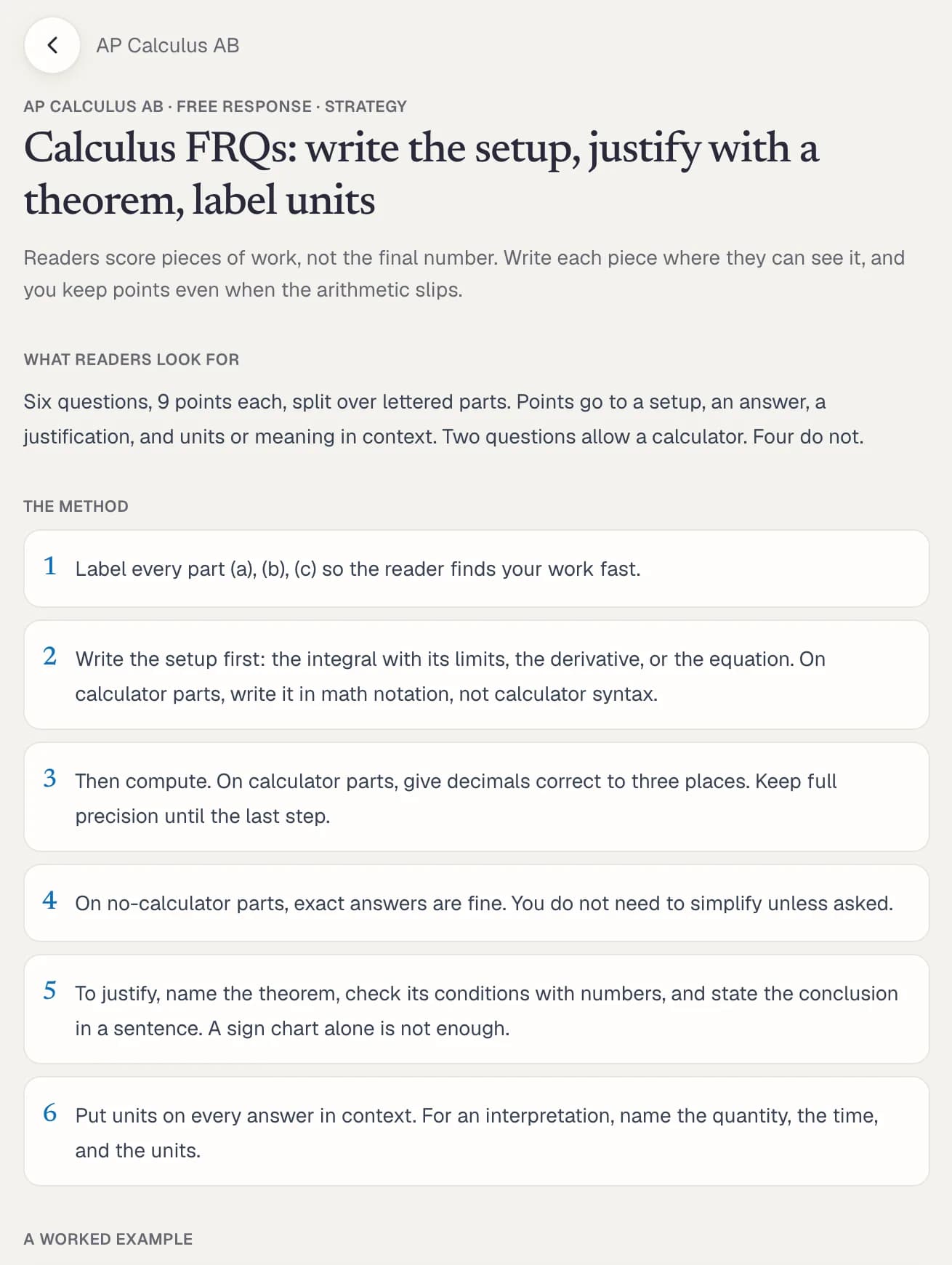
A strategy lesson in the web app: Calculus FRQs, write the setup, justify with a theorem, label units. It says what readers look for, then lists a six-step method.
Real screenshot. A strategy lesson: how readers hand out the points, and how to earn them.

How grading works

Write it by hand. See every point.

A scripted walkthrough of one question, worked by hand. Press Grade it to watch each point land, and the lost ones turn into review.

A scripted walkthrough — the grading shape, not a live model call.

Free response, graded like a reader would

Point-by-point rubric
Practice · Free response 26 points

Water flows into a tank at a rate of R(t) = 20 + 4 sin(t/3) liters per minute for 0 ≤ t ≤ 12. Water drains from the tank at a constant 22 liters per minute. At t = 0 the tank holds 30 liters.

  1. (a) How much water flows into the tank over the 12 minutes?
  2. (b) Is the flow rate into the tank increasing or decreasing at t = 6? Give a reason for your answer.
  3. (c) At what time t is the amount of water in the tank at a maximum? Justify your answer.
Your work · written on the canvas

(a) ∫₀¹² (20 + 4 sin(t/3)) dt = [20t − 12 cos(t/3)]₀¹²

= 240 − 12 cos 4 + 12 ≈ 259.8 liters

(b) R′(t) = 4/3 cos(t/3),  R′(6) ≈ −0.555. Decreasing.

(c) W′ = R(t) − 22 = 0 → sin(t/3) = ½ → t = 5π/2 ≈ 7.85

Max at t ≈ 7.85 min.

Rubric score
— / 6
  • (a) Total accumulation· / 2
  • (b) Increasing or decreasing· / 2
  • (c) Maximum amount of water· / 2

The courses

13 AP courses, each with its own outline and rubric.

Each course brings its full outline, its own exam sections, and its own free-response rubrics.

Courses covered

13 courses
Math
  • Precalculus4 units
  • Calculus AB8 units
  • Calculus BC10 units
  • Statistics5 units
Sciences
  • Physics 1: Algebra-Based8 units
  • Physics 2: Algebra-Based7 units
  • Physics C: Mechanics7 units
  • Physics C: Electricity and Magnetism6 units
  • Chemistry9 units
  • Biology8 units
  • Environmental Science9 units
Social sciences
  • Macroeconomics6 units
  • Microeconomics6 units

Each one brings its full outline, its own exam format, and free response graded on that course’s rubric. More subjects are on the way; the tutor itself already works in every subject, exam or no exam.

Pricing

Pay once for the test.

AP prep is an add-on to Base. You never need it to use the tutor. Pay for it once, and it is yours to keep.

Compare every plan

AP prep

Launch pricing

AP exams, marked the way a reader marks them.

$20onceor $35 for AP prep and SAT/ACT prep together
  • Needs Base ($20 / month): every subject, the canvas, plans and review
  • Full practice exams, with free response marked point by point
  • One payment, and it is yours to keep
  • 14 days free to start, with no card

FAQ

Questions, answered.

Something not here? Write to us and a person answers: support@getcorollary.app.

AP prep

Which AP courses are covered?

All 13: Precalculus, Calculus AB, Calculus BC, Statistics, Physics 1: Algebra-Based, Physics 2: Algebra-Based, Physics C: Mechanics, Physics C: Electricity and Magnetism, Chemistry, Biology, Environmental Science, Macroeconomics, Microeconomics. Each brings its full outline, its own exam format, and its own free-response rubric.

Are the practice exams full length?

Yes. A practice exam has both sections, multiple choice and then free response, each on its own clock. The clock does not pause. Each paper draws on questions you have not met yet. You get what you scored on that paper, section by section, and never a predicted AP score.

How is free response graded?

You write your answer by hand on the canvas. Cora scores it point by point against a reader-style rubric, and says why each point was earned or lost. Every lost point becomes a review card, so the same miss comes back until it sticks.

Is the AP rubric the real one?

The practice questions are original — we don't use College Board's copyrighted exam items. They're scored with reader-style, point-by-point rubrics built from the public Course and Exam Description, so each point maps to the kind of point a reader awards, with the reason it was earned or lost.

What happens to my price after the exam?

Nothing changes. Base is $20 a month, or $200 a year, and you can cancel it anytime. Test Prep is paid once: AP prep is $20, SAT/ACT prep is $15, and both are $35. Nothing renews after test day. You keep it for as long as you have a Base plan, and if you cancel Base it waits for you.

Do I need Base as well?

Yes. Test Prep is an add-on to Base, so you need a Base plan first ($20 a month). Then AP prep or SAT/ACT prep is a single payment on top. Prep runs on the tutor underneath it, which is why it needs Base.

Your exam date is fixed. Your plan can start now.

Free for 14 days. No card.

AP is a registered trademark of the College Board, which was not involved in and does not endorse this product. Practice questions are original, never College Board exam items.