A general chatbot · verbatim
can you help me with this?
Yes! Your substitution is exactly right:
Let
Change the limits:
- When ,
- When ,
So the integral becomes
Integrate:
It ends with the answer, in a box.
For parents
Your child works by hand. Cora reads the page, asks before she tells, and marks the step that went wrong. A plan keeps them on pace for the test, and every miss comes back in review. Base is $20 a month, less than one hour with most private tutors.
Why not just use a chatbot
A chatbot is great at the answer. It will finish your problem faster than Cora will. Then you have an answer you did not learn to reach. Cora reads your page, shows the method and marks the step that went wrong. Then you take the next step. We asked one model the same question twice, once plain and once as Corollary. Here is what came back.
A general chatbot · verbatim
can you help me with this?
Yes! Your substitution is exactly right:
Let
Change the limits:
So the integral becomes
Integrate:
It ends with the answer, in a box.
Cora · verbatim
Cora
Your substitution is set up correctly. Now change the bounds using and rewrite the integral entirely in terms of .
What are and ?
It ends with a question for you.
Pick one. Each is the same question put both ways, side by side.
∫ x e^x dx
Using integration by parts, let u = x, dv = eˣ dx. Then du = dx, v = eˣ:
∫ x eˣ dx = x eˣ − ∫ eˣ dx = x eˣ − eˣ + C
(x − 1) eˣ + C
It ends with the answer in a box.
Try integration by parts:
∫ u dv = uv − ∫ v du.
Choose one factor to differentiate and the other to integrate. A natural choice is
u = x, dv = eˣ dx.
Then compute du and v, and substitute into the formula. What expression do you get?
It ends with the ball in your court — and in the app “integration by parts” is a link rather than a phrase, worth a definition and a drill without leaving the answer.
Ten characters in, and the replies have already forked. One hands you a boxed answer; one hands the problem back. Same model, same question — the only difference is who is expected to finish it.
The same handwritten page to both — parts set up right, the sign lost on the last line
“Almost — the integration by parts setup is correct, but there’s a sign error in the last step.”
Then the whole thing again, its way, ending:
−(x + 1) e⁻ˣ + C
It read the photo and it found the error. It also finished the problem, and the correction lives down here, under your page.
“The integration-by-parts setup is correct; the only issue is the sign when integrating e⁻ˣ in the last step.”
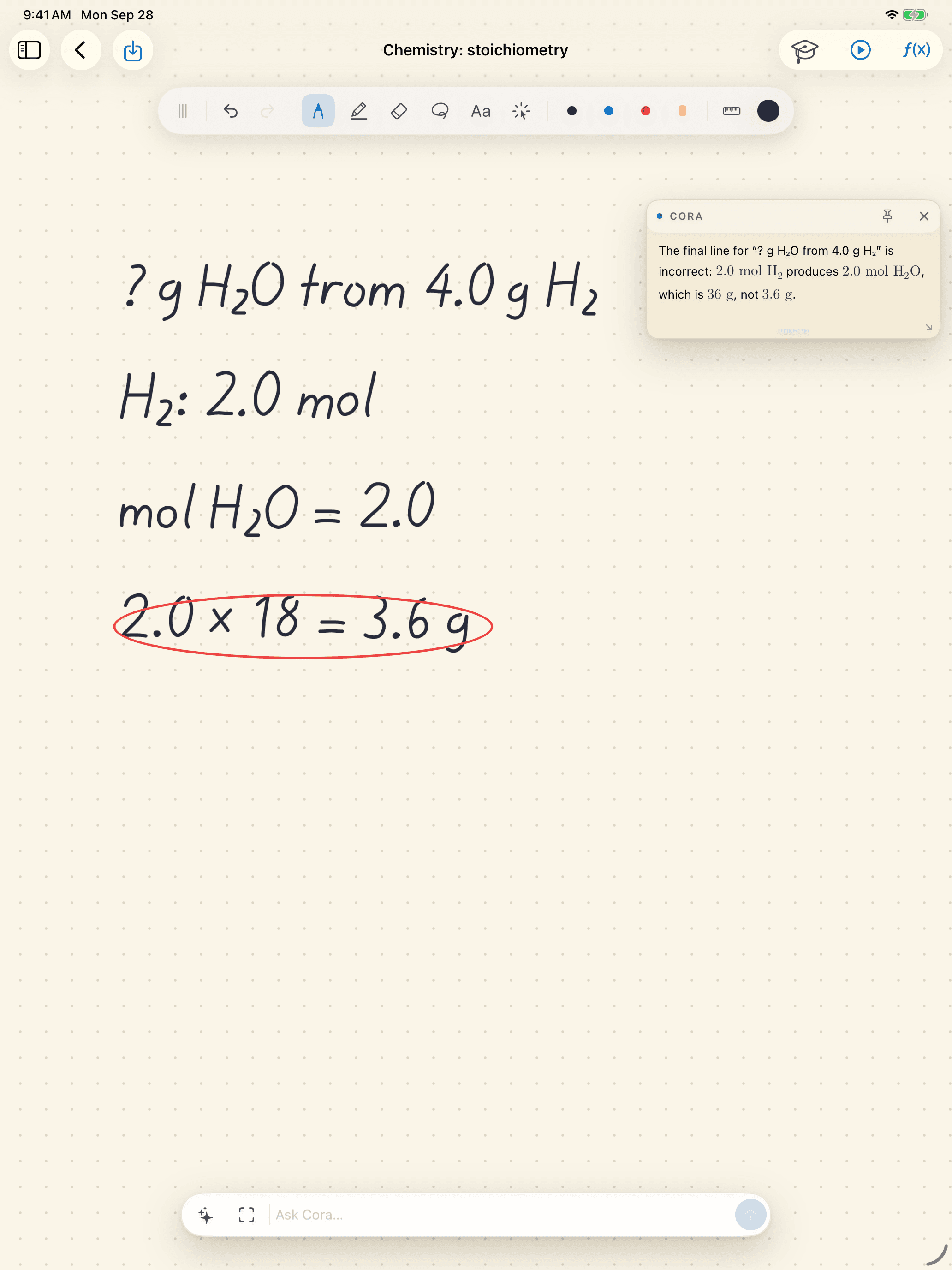
And, in the same reply, a mark placed on the page itself:
= −x e⁻ˣ − ∫ −e⁻ˣ dx
= −x e⁻ˣ + e⁻ˣ + C
{"kind":"ellipse","cx":650,"cy":360,"rx":80,"ry":25}
Real pixel coordinates on your page, and that is where the ring lands.
Both of them found the sign. Only one of them could point at it — on your line, in your handwriting, where you will be looking.
“i expanded (2x−3)^2 and got 4x^2 − 9. check my step”
Your expansion missed the middle term. Use (a − b)² = a² − 2ab + b²:
(2x − 3)² = 4x² − 12x + 9
Correct. It is also exactly as confident when it is wrong, and on a longer expression you have no way to tell those two apart.
The same correction — and then she puts her own claim through the checker, and the server answers:
✗ Equivalence check — expanding (2x-3)^2 — (2*x-3)^2 vs 4*x^2 - 9: NOT equivalent — at x = 1.305, the left side is 0.1514 and the right side is −2.183.
That verdict is arithmetic, not phrasing. It is computed after she has written, at seeded sample points, and it would have contradicted her if she were wrong.
The same block backs a claim about units or a balanced equation, where agreement reads every element and the charge are conserved. Counted, not asserted.
Every tutor can tell you that you are wrong. This one can be checked on the spot, by something that does not care what it just said.
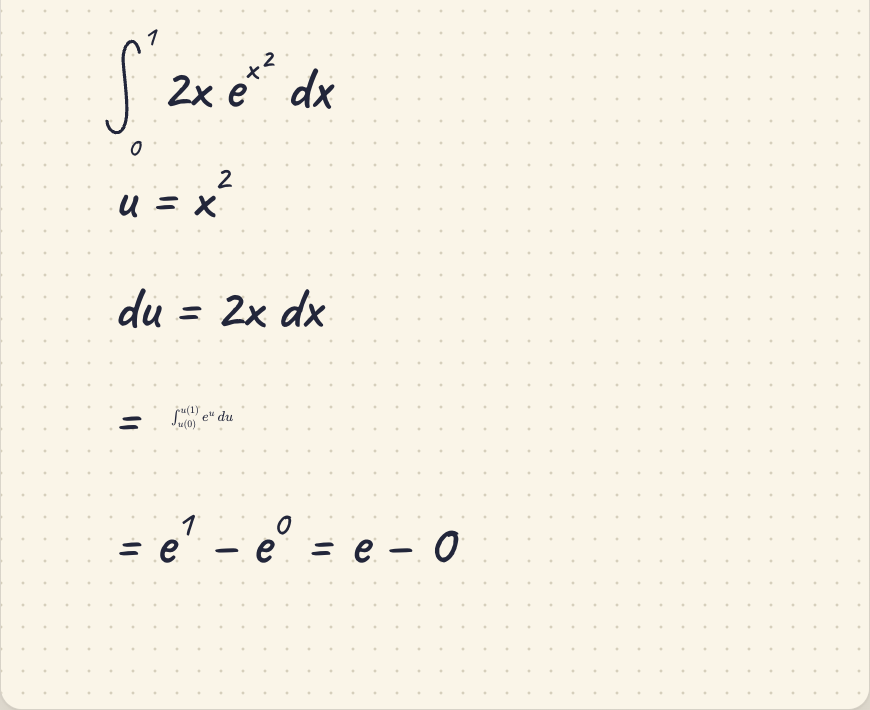
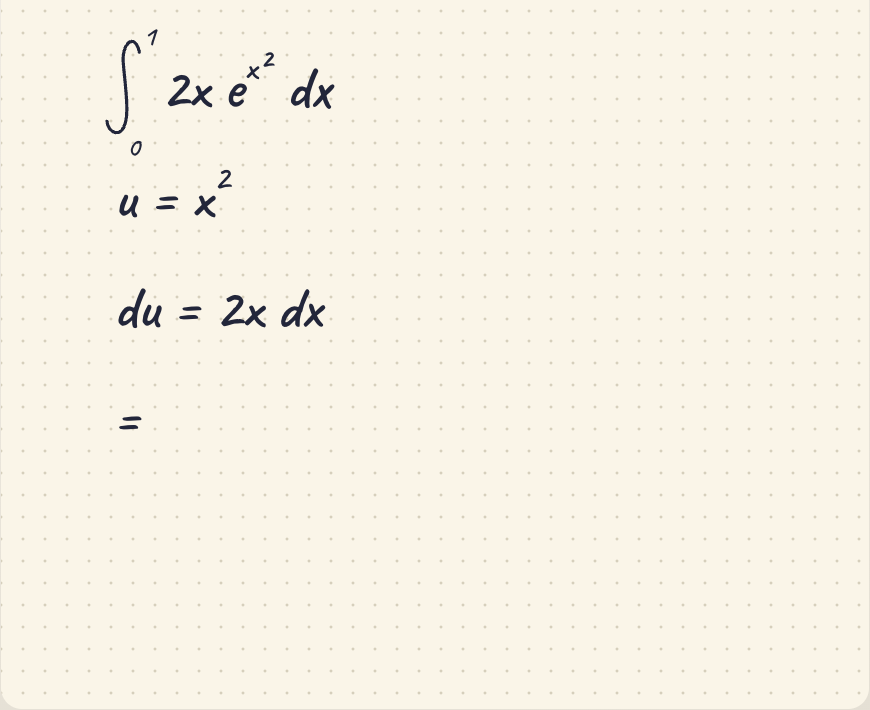
A substitution begun and broken off at “=” — you are working the next step out in your head
A chat box does nothing until you type. So you type, and it takes the page: substitution, changed limits, and
e − 1
“So the blank after du = 2x dx should be ∫₀¹ eᵘ du.”
It filled in the line you stopped on, and then it finished the problem. There is no setting for “not yet”.
It is already looking at the page, on its own, a few seconds after the pen stopped. Its entire reply:
<silent>
The rule it works to is explicit: speak only if you wrote it an instruction, or there is a definite error that will cost you, or you are visibly stuck, or you have finished and it is wrong. A line broken off mid-thought is none of those.
“An unnecessary silence costs nothing; an unnecessary interruption costs my train of thought.”From the instructions Cora is given, verbatim.
Same page, same second. A chatbot cannot help but finish the line you were ten seconds from reaching. Cora holds the one beat you don’t need her, so the thinking stays yours — then speaks up the moment a step actually costs you.
“ohh okay that makes sense, thanks!”
“You’re welcome!” — and the answer once more, for the road.
Nothing is written down, because there is nowhere to write it. The conversation is the only record, and it closes when you close the tab.
Following along felt exactly like understanding. From the inside the two are identical, and nothing here can tell them apart.
Asked the same thing, Cora is just as warm — the difference is not in the reply. It is that a row gets written, and how much that row is worth is fixed in advance by how hard it is to fake:
The weights the app actually uses. So “thanks!” lands at 0.20, and it is quietly out-voted the moment you get one marked.
Both of them said something kind. Only one of them also wrote down how much it was worth — and it does not believe your word over your work.
The sign you dropped, over the following nine days
A new chat. It has never met you, and the sign error is gone along with everything else you worked on.
You can paste the old thread back in — and then you are the one keeping the records, deciding what to revisit, and remembering on which day.
Nothing brings back the thing you were quietly about to forget, because nothing is tracking it.
The slip became a card, and the scheduler decides when you see it again. This is that card’s real life:
Run through the app’s own scheduler, FSRS, the one Anki adopted. The gap widens only because you keep getting it right, and it collapses the moment you do not.
A chat ends. A tutor keeps the thread, and hands it back on the day it is worth the most.
Neither reply in a verbatim panel is written prose. The four marked are word-for-word replies, captured by asking one model the same question twice — once with a bare “you are a helpful assistant” system prompt, once with the system prompt Corollary actually ships, with the same page attached where there is a page. Same model on both sides, so the only variable is the teaching. The two marked computed contain no model turn at all: those figures come from running the app’s own scoring and scheduling code, because what is claimed there is what gets recorded and when it returns, not what anyone says. Their chatbot column carries no mark, and deliberately: it is our illustration of how a fresh assistant behaves, not a capture of one, and a provenance label on something with no provenance would be the one mistake this section cannot afford. Replies are trimmed for length, never reworded, and the check verdict is quoted to the digit. The left column is a general assistant with no teaching prompt. Some tools now offer a study mode that asks questions first, and this comparison does not test those.
For parents
“I’m a machine, and I say so. I won’t pretend to be a person, and I’ll never talk anyone out of going to one.”— Cora
Corollary is for students aged 13 and over, and more of these questions are answered in the FAQ.
Pricing
Try everything free for 14 days. Base is the whole tutor: every subject, the canvas, plans and review. Test Prep adds 13 AP courses and the SAT and ACT, as add-ons you pay for once and keep. You only need them if you’re sitting an exam.
Your everyday tutor.
or $200 a year ($16.67/mo) · two months free
$200 billed once a year · two months free
For the month, less than a single hour with a human tutor.
Choose BaseFull access. See if it clicks.
No card, so there is nothing to cancel if you stop.
Start freeAdd it to Base. Pay once, keep it.
Each add-on is one payment and yours to keep. Both together are $35. Needs a Base plan.
Start test prepEvery plan starts with the same 14-day trial, everything on and no card. After it, your work stays yours, and Cora needs a plan: Base for the everyday tutor, and a one-time Test Prep add-on for the exams. Nothing is ever charged without a plan you chose.
Launch pricing — the first cohort helps set the real numbers.
AP and SAT are registered trademarks of the College Board, and ACT is a registered trademark of ACT, Inc. Neither was involved in or endorses this product.
FAQ
Something not here? Write to us and a person answers: support@getcorollary.app.
Not by default. Cora starts with a question or a hint, not the answer. When a student is stuck she gives the next question rather than the next line. A student can switch her to a mode that shows the worked steps, so this is a default, not a lock. Work is done by hand on the canvas, so the student writes the steps and Cora marks them. In a study plan, a step counts as learned only once the student shows it on their own: in the session, in marked handwritten work, or in a short exit ticket taken without help. A question they miss comes back in review.
13 and over. Date of birth is asked when an account is made and one is not created below that age. Accounts we know belong to a minor get extra protections — a periodic reminder to take a break, a standing reminder that Cora is a machine, and no per-user behavioral analytics. Read the safety page.
Cora stops tutoring, says plainly that she is a machine and cannot be what they need, and points them to a crisis line and to an adult they trust. Separately, and not depending on the model getting it right, a rule puts the crisis numbers on screen before the reply is even written. It is not a monitoring service and it does not alert anyone — the published protocol says exactly what it does and does not do. Read the crisis protocol.
The work is theirs. We don't sell data, there are no advertising or third-party tracking SDKs in the app or on this site, and the only cookie the site sets is the one that keeps you signed in. Accounts belonging to a minor are excluded from per-user analytics entirely — that usage is counted in aggregate and cannot be traced back to a person. An account can be deleted from Settings, which removes the work with it. Read the privacy policy.
From account settings, at any time, without emailing anyone — it opens the billing portal where you can cancel, change your card or download an invoice. You keep access until the period you've paid for ends, whether that is a month or a year. Read the terms.
A general chatbot is built to finish your problem, and it does that well. Corollary is built so you can finish it. Cora reads your handwriting, shows the method, marks the line that went wrong, and gives you the next step to try. Around that sits what a chatbot does not keep: a plan paced to your date, review cards made from your misses, and grading against a rubric. See one model answer the same question both ways.
Math, chemistry, physics, biology, economics and foreign languages, plus a general mode for everything else. Each one has its own tutor with its own voice and notation — chemistry gets mhchem and mechanism diagrams, languages get stroke-order handwriting on the web — and every subject gets the same canvas, drills, plans, and spaced review.
Try it with your child when it opens.